

The Midwife’s Unclaimed Washbasin
Background
Origin and creation
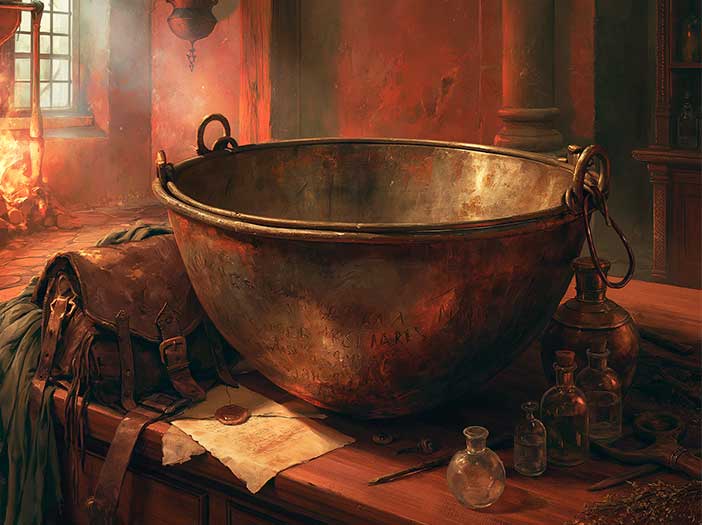
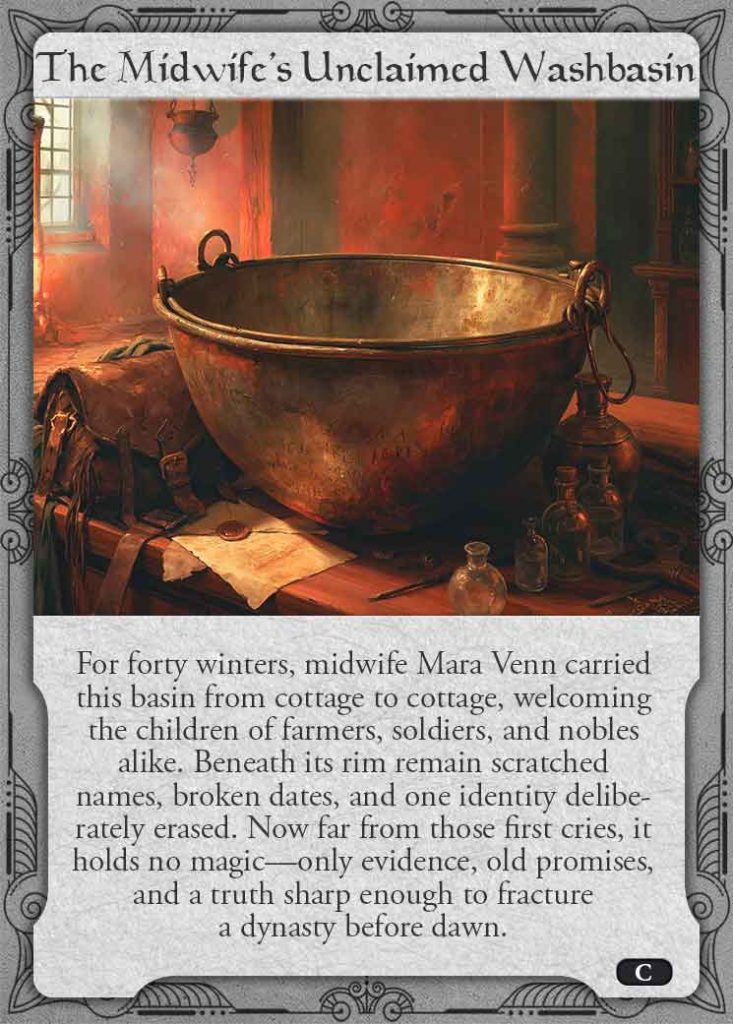
The basin was hammered from plain tin by a village smith whose wife had survived a dangerous birth. He gave it to Mara Venn, the midwife who had saved her, refusing payment and asking only that no mother in the valley be turned away for lack of coin. Mara carried it between farmsteads for nearly forty years, wrapped in an old flour sack to keep it from rattling against her instruments.
Everyday use / original function
Mara used the basin for washing linens, cooling fevered brows, and cleaning newborn children before placing them in waiting arms. Families came to recognize its dull rim beside the hearth as a promise that someone competent had arrived. After Mara’s death, the basin passed among younger midwives, though each insisted that difficult births seemed to find whoever possessed it—not through sorcery, but because frightened families remembered its shape and sought it out.
Key events the object was present at
During the winter called the Long Hunger, the basin was used in the cellar of a besieged manor where six children were born while soldiers searched the upper rooms. Years later, it appeared at the birth of Lord Carrow’s only acknowledged heir. The child died before dawn, and the basin vanished from the chamber before the household servants were questioned. It resurfaced recently in a roadside shrine, filled with rainwater and copper offerings.
A hidden secret linked to the item
Scratched beneath the basin’s base are the names of children Mara delivered, along with tiny marks indicating those born to parents who concealed their identities. One name has been deliberately scraped away, but the date beside it matches the birth of the reigning duchess. An elderly laundress claims the missing name belonged to a stable hand’s daughter—and that the infant carried from the room wore the duchess’s family ribbon.
Adventure Hooks
- A young midwife purchases the basin from a shrine keeper and soon receives threats demanding its destruction. She believes the danger concerns the noble birth recorded beneath it. The shrine keeper has disappeared, leaving behind a cart packed for a hurried journey. Several powerful families now claim the basin was stolen from them.
- Lord Carrow’s surviving relatives offer a generous reward for the basin, insisting it is a private memorial to his dead heir. A former servant says the child did not die but was exchanged for another infant during the confusion. She will reveal where the surviving child was raised, but only after seeing the scratched names herself. Someone has already begun hunting every witness from that night.
- Villagers in the valley refuse to let the basin leave, believing Mara’s promise still binds its owner to aid any mother who asks. A merchant has legally purchased it and hired guards to carry it away. On the road, a desperate family approaches with a woman already in labor. The dispute may become violent before anyone remembers what the basin was actually made for.
- The erased name beneath the basin can be partly reconstructed by comparing Mara’s old household accounts with parish records. Unfortunately, the relevant records were sold to a monastery across a disputed border. Agents of the duchess are also seeking them, publicly to correct an archival error. A retired priest warns that the truth could invalidate several inheritances and reopen an old civil war.
- Copper offerings taken from the basin bear the stamped marks of children delivered by Mara’s successors. One coin belongs to a person now accused of being an impostor. The accused claims the coin was left by their birth mother as proof of identity. Establishing its history requires finding the midwife who last possessed the basin, a woman believed to have drowned years ago.
- A remote household sends for the basin after their expectant mother begins repeating Mara Venn’s name, though she has never heard it before. The family suspects a curse, but the explanation may lie in concealed letters and an inherited fear passed down through generations. The journey grows urgent when armed riders appear, determined to prevent the birth. They carry no heraldry, only flour sacks identical to the one that once wrapped the basin.
Rumors
- “Mara never wrote down a child’s name until she was certain the mother would live.”
- “The basin belonged to the ducal family long before the midwife carried it. They only pretend otherwise because of what was washed from it.”
- “Every copper left inside came from someone who owed their life to Mara Venn.”
- “The missing name was not scraped away. The tin was cut from beneath and patched so neatly that only a smith would notice.”
- “Lord Carrow’s heir cried once after the household announced the child dead.”
- “A woman who sees her own name beneath the basin will learn nothing pleasant about her parents.”
- “The shrine keeper sold the basin three times, yet it was always back beneath the shrine roof by morning.”
- “Mara delivered one child without ever seeing the mother’s face. Everyone in the room wore mourning veils.”
- “The duchess keeps an empty cradle locked in the western tower and orders it dusted every week.”
- “It is only an old washbasin. The stories survive because noble blood is easier to swallow when served with scandal.”
Optional
- Passive. When filled with clean water, the basin gently warms or cools the water to a comfortable washing temperature. This effect cannot make the water hot enough to burn or cold enough to freeze.
Common Questions
Low resolution preview:

![[D&D] The Ferryman’s Last Lantern 5e Trinket](https://oneman-rpg-studio.com/wp-content/uploads/2026/06/0002-The-Ferrymans-Last-Lantern-mock.jpg)
![[D&D] The Rain-Sworn Cobbler’s Awl 5e Trinket](https://oneman-rpg-studio.com/wp-content/uploads/2026/07/0003-The-Rain-Sworn-Cobblers-Awl-mockup.jpg)