

The Ferryman’s Last Lantern
Background
Everyday use / original function
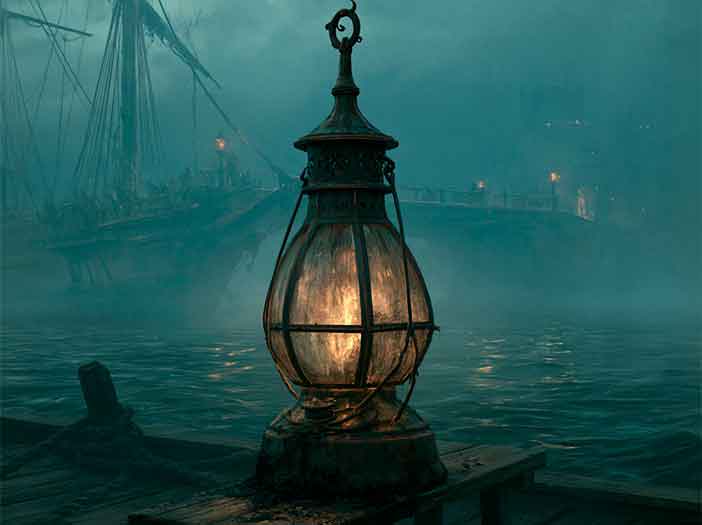
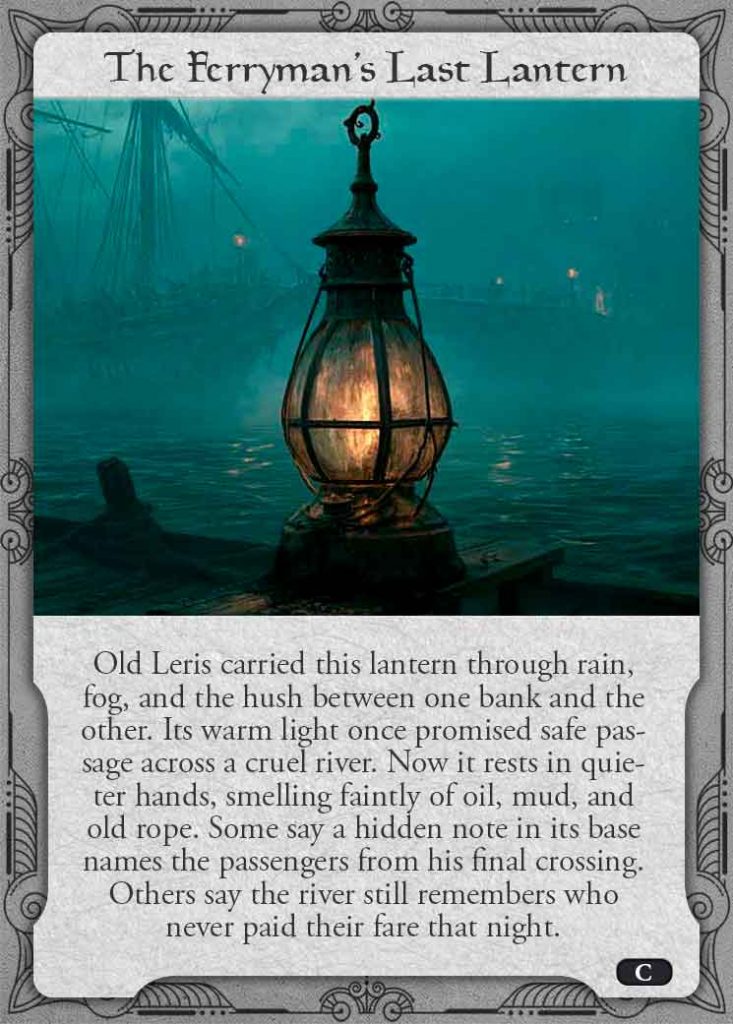
This squat iron lantern was made for a river ferryman who worked the crossing at a narrow, treacherous bend of a wide brown river. Its frame is sturdy but unremarkable, built to withstand spray, mud, and constant knocking against the prow of a small boat. On most days it simply hung from a hook by the ferryman’s side, its glass panes smudged with thumbprints and river mist, its light meant to warn barges at dusk and reassure nervous passengers in the dark hours. Its metal is stained in places where wet rope and riverweed once slapped against it, carrying the smell of silt and tar. For years it was nothing more than part of the scenery of the crossing: a dull glow in the fog, a practical tool in a working man’s hand.
Notable owners or bearers
The first and most famous owner was Old Leris, a patient man who knew every eddy, sandbar, and hidden snag within three days’ walk of the crossing. He kept to himself, but travelers remember his quiet jokes, the way he’d tap the lantern’s side before pushing off, as if asking the river’s permission. After Leris never returned from a late-night crossing in a storm, the lantern, recovered tangled in reeds downstream, passed into the care of his niece, Mara. She never took up ferry work—too many ghosts in the water, she said—but she kept the lantern above her door as a sign for those who needed small favors: a loan of grain, a place to sleep, someone to listen. Since then, the lantern has changed hands a few more times, always among people who live close to water and other people’s secrets.
A hidden secret linked to the item
Inside the lantern’s base, beneath a rust-flecked plate held by two old screws, lies a narrow space lined with oiled cloth. The compartment was Leris’s private hiding place, used for folded scraps of paper, pressed wildflowers, and the occasional coin slipped to him for “no questions asked” crossings. When the lantern was fished from the reeds after his disappearance, that compartment held a single item: a short, water-speckled note naming three passengers from his final night and a half-erased phrase that might be read as “don’t let them…” The note has since vanished, stolen or destroyed by someone who knew to look for it. The hidy-hole remains, unsuspected by most current owners, still faintly smelling of river mud and lamp oil, waiting for something else to be hidden inside it.
Adventure Hooks
- The party reaches a small riverside village where a faded lantern hangs above a cottage door, its glass panes more scratched than clear. The owner, an aging woman with sharp eyes, explains that this is the very lantern from the old crossing, and that lately, its light has begun to sway and dim on calm nights, as if caught in an invisible storm. Locals whisper that whenever the lantern falters, someone in the village goes missing within three days. The woman asks the characters to investigate the riverbank and boathouse where Old Leris once worked, claiming that answers—and perhaps the cause—must lie in whatever happened on his last night. She’ll let them take the lantern, but insists they bring it back “with fewer ghosts in it.”
- A nervous young courier hires the party to escort them and a small locked chest to a distant city, insisting that they travel by river. They carry the Ferryman’s Last Lantern, which must be kept lit at all times during the journey; extinguishing it, the courier claims, will alert certain people that the chest has left safe hands. River bandits seem strangely fixated on the lantern rather than the chest, trying to snatch it and throw it into the water. If the party inspects the lantern carefully, they may discover the hidden compartment—and a folded scrap that hints at an old, unfinished smuggling route mapped along the riverbanks. Whether they choose to follow that shadowy route or complete the courier’s mission honestly will shape who comes after them next.
- A local shrine keeper begs the party to recover an old ferryman’s lantern that was stolen from the shrine of river saints. The thief, a repentant former smuggler, claims that the lantern once belonged to their crew’s guide and contains proof of a betrayal that doomed them years ago. Rival factions—remnants of the smuggler band, river wardens wary of old scandals, and villagers who see the lantern as a holy relic—begin closing in as the party tracks the lantern from hand to hand. Each group tells a different, conflicting version of Old Leris’s final crossing, forcing the characters to decide whom to believe. In the end, the hidden compartment may hold the last surviving piece of evidence, and the party must choose whether to reveal or bury the truth.
- During a flood season, the river rises and drowns the old crossing road, stranding farms on both banks. A desperate mayor offers a reward to anyone who can recreate the once-steady ferry link, claiming that an old lantern used by the legendary ferryman could help restore trust and calm. When the party tracks the lantern down, its current owner will only lend it if they agree to uncover what really happened to Leris and the three passengers who disappeared with him. Investigation leads the characters to a half-collapsed riverside tavern, a riverlord’s abandoned barge, and the remnants of a forgotten tax ledger that suggests someone paid very well for those three passengers to vanish. The lantern becomes a symbol during negotiations, its presence at the new crossing stirring old fears that the river is claiming a price again.
Rumors
- Some say Old Leris never drowned at all; he simply walked away from the river one foggy morning, leaving only the lantern behind as a polite farewell.
- There’s an old wives’ tale that if you hang the lantern on a boat and push off alone at midnight, the current will carry you to the one person you’re most afraid to see.
- A bargeman swears he once saw the lantern’s light bobbing along the river with no boat beneath it, gliding upstream against the current like a firefly with somewhere important to be.
- The scribbled note once hidden in the lantern’s base supposedly named a minor noble who paid for those final secret passengers, but anyone who tried to read the name out loud choked on river water.
- Some villagers insist that when the lantern was first pulled from the reeds, its glass was bone-dry inside, as if the river had refused to enter it.
- A smugglers’ tale claims that every time the lantern has changed hands over the years, someone nearby has vanished quietly within a season—no screams, no struggle, just empty beds and drifting boats.
- There’s a rumor that the lantern actually belongs to the river itself, and that anyone who keeps it for more than a year must give the water a name in return.
- An old priest mutters that if the lantern is ever lit from a flame taken directly from a funeral pyre, the ghosts of Leris’s last three passengers will finally finish their journey—wherever it was meant to end.
Common Questions
Low resolution preview:


![[D&D] The Midwife’s Unclaimed Washbasin](https://oneman-rpg-studio.com/wp-content/uploads/2026/08/0005-The-Midwifes-Unclaimed-Washbasin-mockup.jpg)
![[D&D] The Rain-Sworn Cobbler’s Awl 5e Trinket](https://oneman-rpg-studio.com/wp-content/uploads/2026/07/0003-The-Rain-Sworn-Cobblers-Awl-mockup.jpg)