

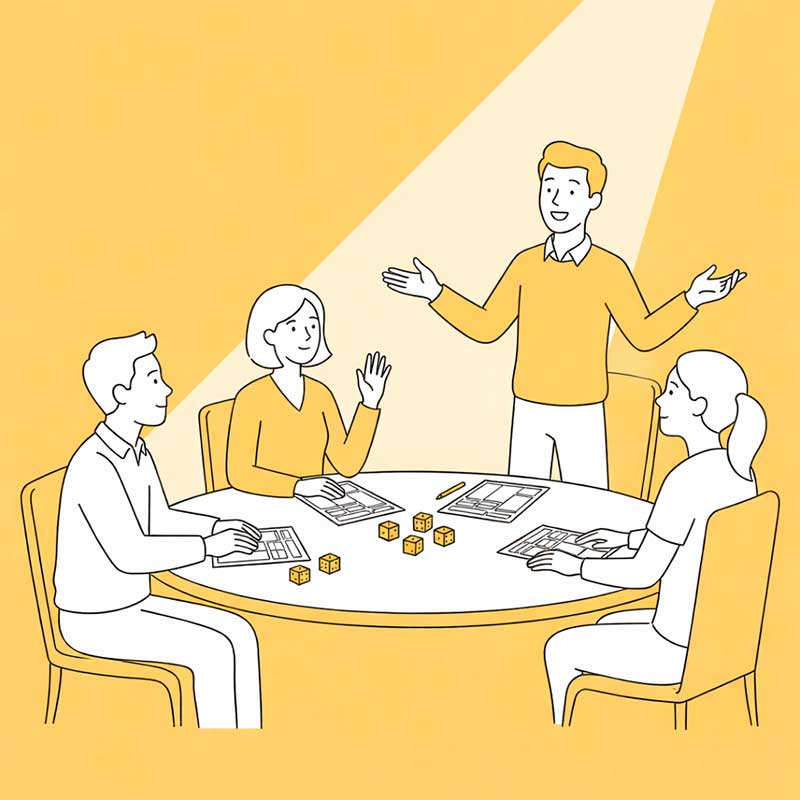
How do I share the spotlight when one player always talks first?
You know the moment. You ask, “What do you do?” and before anyone else’s brain has even loaded the scene, one player is already negotiating with the mayor, volunteering the party for a suicide mission, and picking the door lock with their face.
Sometimes that player is just enthusiastic. Sometimes they’re anxious in silence. Sometimes they genuinely think they’re helping the table “keep momentum.” But the end result is the same: other players start drifting into spectator mode, and your game quietly becomes “The Adventures of Whoever Speaks First.”
The fix isn’t to punish the loud player or force quiet players to perform. It’s to build a table rhythm where everyone gets clear openings, decisions happen with shared buy-in, and the fast-talker has a lane that doesn’t run over everyone else.
- Why This Matters for Your Game
- Key Ideas to Keep in Mind
- ➤ Call out the pattern, not the person
- ➤ Use “camera moves” to hand the scene to someone specific
- ➤ Set a “no puppeteering” norm: everyone speaks for their own character
- ➤ Run “soft initiative” in social scenes when the air gets crowded
- ➤ Give the fast-talker a job that helps without hogging
- ➤ Reward the behavior you want, immediately
- Final Thoughts for Your Next Game
- Common Questions
Why This Matters for Your Game
Spotlight isn’t about fairness in some abstract moral sense. It’s about engagement. When players feel like their choices matter, they lean forward. When they feel like choices get made for them (even accidentally), they lean back.
If one voice dominates, a few things creep in fast:
- Decision ownership gets muddy. The party agrees to stuff they didn’t actually agree to. Later, you get that classic vibe: “Wait, why are we doing this again?”
- Character identity blurs. Quiet players stop making character-driven calls and start following the loud player’s plan, even when it doesn’t fit their PC.
- You lose your best fuel: contrast. The fun of a party is different viewpoints colliding in a friendly way. One viewpoint steamrolls that texture flat.
- Resentment builds silently. Most people won’t complain. They’ll just disengage… and you’ll feel like you have to work harder and harder to keep energy up.
When you manage spotlight well, the whole table gets easier to run. Players collaborate instead of compete for airtime. Your scenes land cleaner. And the loud player often relaxes—because they no longer feel like they have to “carry” the game.
Key Ideas to Keep in Mind
➤ Call out the pattern, not the person
If you do only one thing, do this. Treat it like a table habit you’re adjusting together, not a personality flaw you’re diagnosing.
Between sessions (best), message or chat briefly:
- “Hey, I love your energy. I’ve noticed you jump in fast, and some folks don’t get a clean opening. Next session I’m going to start directing questions around a bit so everyone gets space. I’d love your help with that.”
At the table (light touch), use neutral language:
- “Cool—hold that thought. I want to check in with a couple other people first.”
- “Let’s do a quick sweep: I’m going to hear one idea from each of you.”
This framing keeps you out of the “DM vs. Player” trench war. You’re not telling them to shut up. You’re adjusting pacing.
➤ Use “camera moves” to hand the scene to someone specific
When you ask the whole table “What do you do?” the fastest voice wins by default. Instead, make your question aimed.
Try:
- “While that’s happening, [Quiet Player], what does your character do in this moment?”
- “[Player], you’re the first to notice the guard’s hands shaking—what do you say?”
- “[Player], you’ve dealt with this kind of place before. What’s your read?”
This works because you’re not asking someone to perform out of nowhere—you’re giving them a clear handle. It also lets you distribute spotlight without announcing “SPOTLIGHT TIME,” which can feel awkward.
A good rhythm is: Group question → targeted question → bounce it back to group.
- “What’s the plan?”
- “Okay, you, what’s your character’s priority here?”
- “Cool. Does anyone disagree or want to add something?”
➤ Set a “no puppeteering” norm: everyone speaks for their own character
A common spotlight bully move is unintentional: “You should do X,” “We do Y,” “He’s fine with it,” “She opens the door.” That last one is the killer: narrating someone else’s actions.
You can stop it gently and consistently:
- “Hold up—only they can decide that. [Other Player], what do you do?”
- “That’s a suggestion, not a decision. Let’s hear their call.”
- “You can propose it in-character, but they choose.”
If you want a table rule that doesn’t feel like a rule, use this phrase:
- “Pitch, don’t pilot.”
People can offer ideas; they can’t drive someone else’s character.
This is especially important in tense scenes. Nothing drains a player faster than being told what their character feels, believes, or does.
➤ Run “soft initiative” in social scenes when the air gets crowded
You don’t need full turn order like combat. You just need structure when everyone’s trying to talk at once—or when one person keeps grabbing the mic.
Use a quick, casual tool:
- “Let’s go around once—what does each of you say or do in this conversation?”
- “Popcorn order: after you speak, you pick who goes next.”
- “I’m going to take two voices, then we’ll loop back.”
The magic is that you’re not stopping roleplay—you’re making room for it.
A particularly good move is the “two-sentence turn.”
- “Give me your point in two sentences, then we pass it.”
It keeps momentum, it prevents speeches, and it trains everyone to be punchier.
➤ Give the fast-talker a job that helps without hogging
Often the dominant player is a natural organizer. Great! Use that. Just redirect it away from decision monopolies.
Examples:
- Recap Captain: “Start each session with a 60-second recap.”
- Scribe/Quest Log: “Track names, promises, and open hooks.”
- Rules Runner (light): “If we get stuck, look up the page—then we decide.”
- Caller (rotating): “One person summarizes the party’s plan after everyone weighs in.”
The key is the word summarize. They don’t decide. They reflect the group back to itself:
- “Okay, I’m hearing stealth first, talk second, and we avoid killing guards if possible—right?”
That scratches their “I want to help” itch and reinforces shared ownership.
➤ Reward the behavior you want, immediately
When a quieter player speaks up, treat it like the most valuable thing that happened all night. Not with cheesy applause—just with attention and consequence.
- Ask a follow-up question.
- Let their idea matter.
- Put the next beat in their hands.
And when the loud player leaves space? Acknowledge it privately or casually:
- “Thanks for letting that breathe—great moment.”
People repeat what gets reinforced.
Final Thoughts for Your Next Game
You don’t need to “fix” anyone’s personality. You just need table habits that don’t default to “whoever talks first gets the steering wheel.” Aim your questions, protect character agency, and add a little structure when the air gets crowded.
If you want a simple experiment for next session, try this combo:
- Ask one group question, then directly invite two specific players before opening it back up.
- Use “Pitch, don’t pilot” once, kindly, the first time someone narrates another PC.
- Do one “soft initiative” round in a social scene where voices usually pile up.
Small moves, repeated consistently, change the whole feel of your table. And the best part? When everyone gets a real opening, you’ll start hearing plans, instincts, and character choices you didn’t even know your players had.
Common Questions
