

How Do You Keep the Game Moving When Players Overthink Every Choice?
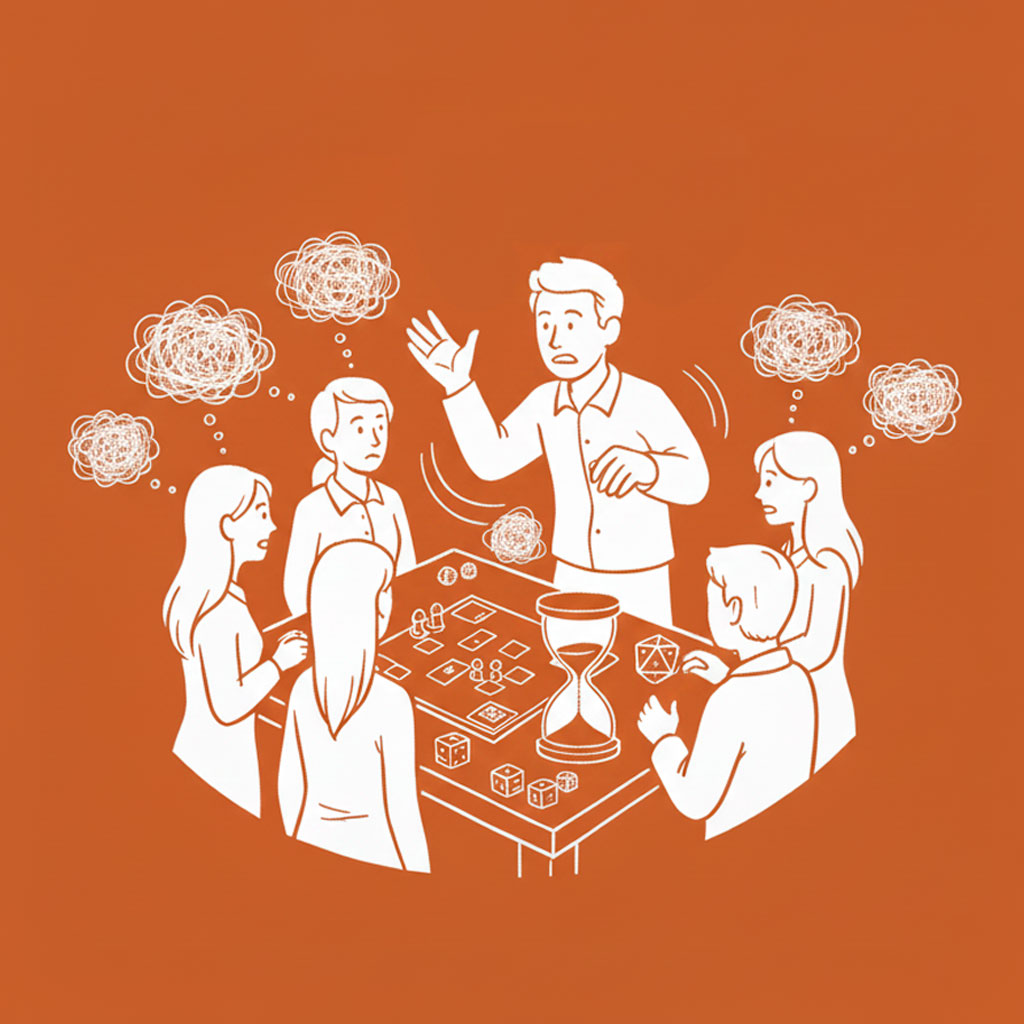
You know the moment: the party reaches a fork in the road, or a locked door, or a suspiciously quiet hallway… and suddenly everyone freezes like they’re defusing a bomb. Ten minutes pass. Then twenty. They debate, they re-debate, they analyze hypothetical outcomes you never even imagined, and the game’s energy slowly faceplants.
Overthinking happens at every table. The trick isn’t to bully players into speed—it’s to shape the flow so they feel confident making choices without dragging the entire session into analysis paralysis.
Let’s talk about how you keep momentum without steamrolling the group.
- Why This Matters for Your Game
- Key Ideas to Keep in Mind
- ➤ Make the Situation Clearer Than You Think You Need To
- ➤ Ask for Intent First, Then Describe Possible Approaches
- ➤ Use Soft Timers to Create Natural Momentum
- ➤ Offer Progress Instead of Perfection
- ➤ Summarize the Options Out Loud
- ➤ Spotlight a Player When the Group Spirals
- ➤ Use the “Move Forward” Rule Behind the Screen
- Final Thoughts for Your Next Game
- Common Questions
Why This Matters for Your Game
A session’s rhythm is fragile. Once the energy stalls, players shift from “we’re adventurers making bold calls” into “we’re a committee reviewing risks.” When play gets stuck like that:
- Scenes feel longer than they are.
- Jokes, tangents, and meta-talk creep in.
- Immersion drops.
- You, the DM, start scrambling to pull them forward.
Fight that enough times in one night and suddenly the session feels like wading through wet sand.
But when your table has tools to make decisions confidently, something magical happens:
- Sessions feel faster, smoother, and more exciting.
- Players stay immersed in the moment, not the hypotheticals.
- You spend less time repeating details or nudging them along.
- Everyone develops a shared trust that the story won’t implode if they pick “the wrong option.”
Campaigns with strong flow feel alive. Scenes breathe. Stakes land. Players feel clever because they’re acting, not hesitating. And you get to run the game at a comfortable rhythm instead of constantly digging it out of mud.
Key Ideas to Keep in Mind
➤ Make the Situation Clearer Than You Think You Need To
Overthinking often comes from uncertainty, not indecision. If players don’t know what’s at stake or what the obvious choices are, they fill the void with speculation.
When you present a scene, try adding:
- One clear goal: “You’re trying to reach the inner chamber before the ritual finishes.”
- One immediate concern: “The corridor ahead is unstable from the tremors.”
- Two or three visible options: “You can push through, find a safer route, or try to stabilize part of the tunnel.”
You’re not funneling them. You’re giving them a grounded framework so they don’t invent twenty imaginary dangers. Clarity trims the mental fog and keeps things moving.
➤ Ask for Intent First, Then Describe Possible Approaches
Instead of letting players wander into endless debates about method, ask:
“What’s your intent?”
If they answer, “We want to breach the door,” then you offer a few approaches:
- “You can force it open, try to pick the lock, or search the room for a mechanism.”
By anchoring the conversation in intent before mechanics, you shortcut a ton of dithering. You also reaffirm that the game world reacts to their goals, not to their hesitation.
If they still stall, you can follow up with:
“What does your character do in the next 10–15 seconds?”
This keeps decisions grounded in fiction, not meta-theorizing.
➤ Use Soft Timers to Create Natural Momentum
You don’t need a ticking clock in every scene, but subtle pressure keeps players from spiraling.
Soft timers could be:
- Environmental cues
“The chanting is getting louder.”
“Smoke is filling the hallway.”
“You hear footsteps above moving fast.” - NPC urgency
“The scout whispers: ‘We need to move or lose them.’” - Narrative shifts
“As you argue, you notice the sigils pulsing brighter.”
Soft timers tell the table: doing nothing is also a choice with consequences.
That alone dissolves a lot of overthinking.
➤ Offer Progress Instead of Perfection
Players sometimes freeze because they think they need the “correct” answer. Replace “solve the puzzle entirely” with “move one step forward.”
Give choices like:
- “If you try this, you’ll learn something, even if it doesn’t fully work.”
- “Testing the mechanism might reveal how dangerous it is.”
- “You can take a cautious action to get more information.”
Small, incremental actions keep the flow alive while still respecting caution.
If a player says, “We’re not sure—what do we know?” give them a small hint based on their skills, background, or passive info. Not a solution, just velocity.
➤ Summarize the Options Out Loud
After a few minutes of back-and-forth, step in with a clean summary:
- “Alright, I’m hearing three options: climb the wall, wait for the patrol to pass, or try sneaking across now. Did I miss anything?”
This has three magical effects:
- Players feel heard.
- The choices become manageable.
- Someone usually says, “Okay, yeah, let’s just do X.”
A simple summary cuts through meta-talk like a warm knife through butter.
➤ Spotlight a Player When the Group Spirals
When the whole table is stuck in a swirl of “I dunno, what do you think?” you can redirect:
“Ryn, what’s your ranger picking up from the tracks?”
“Talia, how would your cleric approach this?”
You’re not forcing a leader, but you’re giving a player the floor, letting a character’s instincts guide the group, and breaking the loop.
Use this gently and as a tool—not as a hammer—but it works wonders.
➤ Use the “Move Forward” Rule Behind the Screen
If players can’t decide, give the world permission to advance logically.
For example:
- The patrol walks closer.
- A rival group acts first.
- The NPC they wanted to catch leaves the area.
- A creature reacts to their presence.
This isn’t punishment—it’s world consistency.
When the world moves, players realize they should too.
You don’t always need dramatic consequences; even mild shifts are enough to spark action.
Final Thoughts for Your Next Game
Analysis paralysis isn’t a sign of bad players—it’s a sign of players who care about the outcome. Your job isn’t to rush them, but to shape the moment so they feel confident acting rather than spiraling into infinite hypotheticals.
Try these small experiments next session:
- Make one scene crystal clear with goal, concern, and options.
- Use a soft timer in one moment.
- Ask for intent before method.
- Summarize choices when you see the stall beginning.
Each of these nudges your table toward smoother, more decisive play without sacrificing agency. With just a few new habits, your sessions will feel more dynamic, more alive, and a lot less bogged down by the dreaded “team meeting that never ends.”
Common Questions
