

The Mourning Widow’s Bone Comb
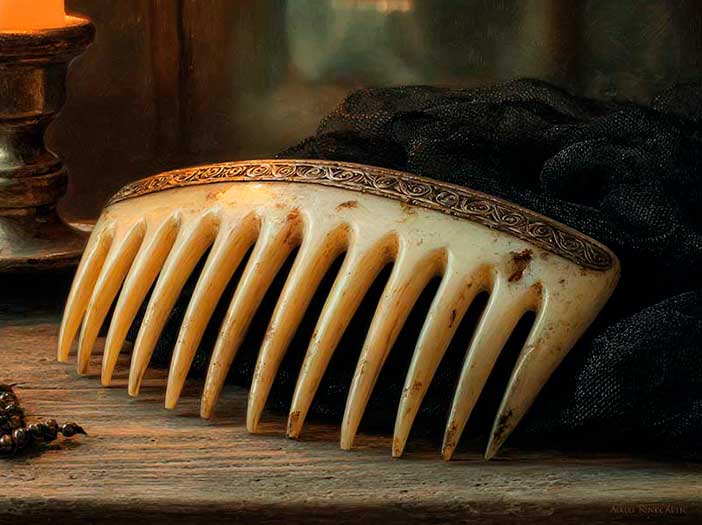
Background
➤ Origin and creation
The comb began as an ordinary piece of vanity: six narrow teeth carved from pale cow bone, polished until they caught the light like milk on porcelain. It was fashioned decades ago by a modest artisan in a riverport city, a man who specialized in simple grooming tools for dockworkers’ wives and market girls who wanted one small luxury of their own. He inlaid a thin brass thread along the spine in a looping pattern that only vaguely suggested flowers; he never had the skill or the money for real ornament, only patience and steady hands. Sold for a few copper coins at a crowded stall, the comb was never meant to be precious—just sturdy enough to keep hair in order against wind, rain, and grief.
➤ Notable owners or bearers
The comb passed first into the hands of Lysa Harrow, the wife of a ship’s mate who never returned from a winter voyage. In the years that followed, neighbors remember her on the threshold of her crooked house, hair streaked with salt and gray, dragging the bone teeth through her curls while she stared toward the harbor with a blank, unblinking patience. When she died, the comb was placed in a small wooden box with a black ribbon and given to her sister, Mara, who kept it near her bed despite always wearing her hair short. Mara in turn left it to her only daughter, a girl who never knew Lysa but grew up hearing how “the widow’s comb” had outlived storm, famine, and three landlords, always turning up again in a drawer, trunk, or coat pocket whenever someone tried to throw it away.
➤ What people believe versus what really happened
Locals whisper that Lysa’s spirit clings to the comb, counting every stroke through the hair of its bearer as one more day stolen from the sea that took her husband. Some claim that anyone who uses it nightly will never lose a loved one at sea, while others insist the opposite—that the comb chooses a family to haunt and will not rest until it has watched each generation mourn at least one drowning. The truth is less tidy: the comb has simply been passed along out of habit and small-town superstition, its survival owed more to sentimentality and coincidence than curse. It has been dropped in gutter water, forgotten in an inn room, and once pawned for a night’s lodging, only to be bought back by someone who recognized the brass pattern and felt a pang of pity. No ghost tugs at its teeth, but the stories around it have grown so thick that anyone who holds it now can feel the weight of imagined eyes, watching from the direction of the harbor.
Adventure Hooks
- A sailor’s widow presses the comb into a character’s hand before a dangerous voyage, begging them to “break the chain” by casting it into the deepest water they find. When the crew learns what the comb is supposed to be, factions form: some demand it be kept as protection, others see it as bad luck, and a few want to sell it to a collector of macabre heirlooms. The tension grows with every storm and accident, and the party must decide whether the object’s meaning or the stories surrounding it are more dangerous to morale.
- A minor noble obsessed with genealogy hires the party after discovering that the comb appears in several old family portraits from different branches of their lineage. He is convinced that whoever currently owns the comb is a “true heir” with a claim that could overturn existing inheritances. The characters must trace the object’s path across cramped tenements, dockside taverns, and forgotten attics, learning uncomfortable truths about how the noble’s wealth was built on the misfortunes of the families who once held the comb.
- In a coastal town, a string of disappearances coincides with a folk ritual in which young lovers secretly exchange small tokens of everyday gear as promises of fidelity. The Mourning Widow’s Bone Comb is among the traded objects, and several missing people are linked by having used it shortly before vanishing. As the party investigates, they discover that a smuggler ring is using the ritual as cover to pass coded messages carved in tiny nicks along the comb’s teeth, and the vanishings have more to do with human cruelty than any lurking spirit.
- A temple devoted to a sea god publicly denounces the comb as a blasphemous charm that “steals” the rightful sacrifices of the waves. A zealous priest demands that the characters escort him to retrieve and ritually destroy it, promising favor and introductions in high places if they succeed. Along the way, they meet people whose lives are entangled with the comb’s story—some who have built their grief around it, others who rely on the hope it represents—and must choose whether to help erase this small, fragile piece of communal myth or protect it from holy fire.
Rumors
- “If you count exactly one hundred strokes with that comb before a voyage, the sea cannot take you—only someone you love instead.”
- “The bone isn’t from a cow at all; it’s carved from the rib of the first man who drowned when the harbor was dug.”
- “Every woman who owned that comb died staring out a window, as if she were still waiting for someone to come home.”
- “A dockside barber swears he once saw the comb move on its own, sliding across the table toward a mirror as if it wanted to see itself.”
- “A collector in the capital pays gold for any item tied to famous tragedies; word is he’s been hunting for this comb for years and doesn’t care who gets hurt bringing it to him.”
- “There’s a crack in the spine of the comb that only appears on nights of rough weather, like a fault line in the sky reflected in bone.”
- “Old Mara tried to burn the comb once, but the fire went out and her house filled with seawater smell for days afterward, even though she lived two streets inland.”
- “Some sailors say you can hear distant waves if you press the comb’s teeth gently into your scalp and close your eyes—but others claim what you hear isn’t waves at all, but voices asking why you’re still alive.”
Common Questions
