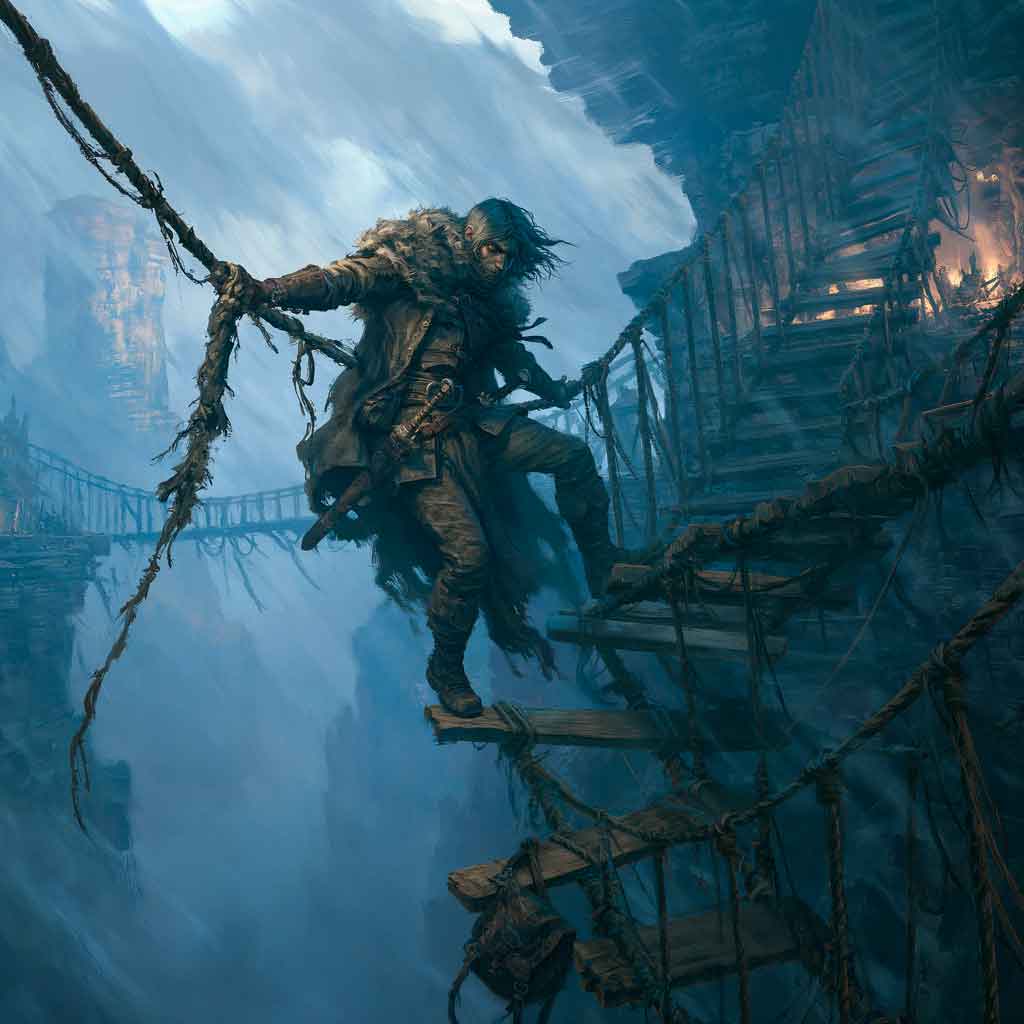
Living Load — Pressurized 5e Inventory
Objective
Living Load turns 5e inventory into a visible decision during tense scenes, without counting pounds or rebuilding the whole character sheet. It is an alternative to exact-weight encumbrance or fixed slot systems: here, equipment matters when it enters the scene, when it is strained, when it gets in the way, or when it saves an action.
The recurring table problem is clear: many groups want load, loot, and gear in DnD 5e to matter, but they reject heavy bookkeeping or constant penalties. This subsystem does not replace normal inventory. It activates only when there is real pressure.
How to Act
- The player declares intent → “I want to cross quickly with the chest,” “I want to draw the rope without losing my turn,” “I want to carry the body and keep running.”
- The DM frames the scene → decide whether the load complicates movement, stealth, reaction, combat, or resource extraction.
- The recommended duration is one scene, one 10-minute exploration segment, a short chase, or a combat.
- Load is measured in Anchors, not exact weight.
- Failure should never be a surprise: the DM announces the cost before the first roll.
Specific Instructions
- Define Load Anchors.
Each character has free Anchors equal to their Strength modifier + Proficiency Bonus + 3, minimum 3. An Anchor represents an object that shapes the scene: a full backpack, a large tool, an extra shield, bulky loot, an unconscious body, a fragile package, a heavy secondary weapon, or a critical supply. - Classify only what matters.
Do not track clothing, loose coins, minor components, or narrative objects with no pressure attached. An item takes 1 Anchor if it can be grabbed, dropped, or get in the way. It takes 2 Anchors if it requires two hands, changes posture, or prevents normal running. It takes 3 Anchors if it must be dragged, requires cooperation, or slows down the whole group. - Mark Live Anchors.
A Live Anchor is gear the character can use immediately: a prepared rope, thieves’ tools within reach, an accessible vial, a lit torch, or a shield slung for quick cover. Each character can have 2 Live Anchors. A third is possible, but it imposes Disadvantage on the first movement, stealth, or reaction-based Ability Check of the scene. - Mark Buried Anchors.
Everything else is Buried: inside a backpack, tied down, under other items, or poorly secured. Retrieving a Buried Anchor under pressure requires an action, a free object interaction if the scene is calm, or an Ability Check if there is a threat. Use Dexterity (Sleight of Hand) to pull it out quickly, Intelligence (Investigation) to find it among packed gear, or Strength (Athletics) to free it if it is stuck. - Set DC by pressure, not by item.
Use DC 10 if there is only haste, DC 15 if there is an active threat, and DC 20 if there is immediate danger, occupied hands, or environmental damage. Apply Proficiency Bonus if the character is proficient with a tool, kit, vehicle, or skill that clearly applies.
Prompt: visible cost.
Before the first roll, say exactly what failure risks: movement, item, position, time, stealth, or the package’s integrity.
- Trigger Overload when Anchors exceed the limit.
If a character carries more Anchors than their limit, do not recalculate everything. Mark Overload 1 for each excess Anchor. Each point of Overload reduces Speed by 5 ft during the scene. At Overload 2+, the character has Disadvantage on Dexterity (Acrobatics), Dexterity (Stealth), and Strength (Athletics) checks made to climb, jump, or swim. - Allow Dropping to breathe.
On their turn, or during an exploration scene, a character can drop 1 Anchor without a roll. If they want to drop it silently, keep it from breaking, or leave it within easy reach, ask for Dexterity (Sleight of Hand) or Wisdom (Survival), usually DC 10–15. On a failure, the object is left behind, makes noise, or becomes exposed. - Use Load Tugs.
When a scene strikes the inventory — a fall, shove, chase, closing door, or narratively framed critical hit — the DM can call for a Load Tug: a Strength saving throw or Dexterity saving throw, DC 10/15/20 depending on force. On a failure, the player chooses: lose 10 ft of movement, turn one Live Anchor into a Buried Anchor, or damage a vulnerable nonmagical object. - Let gear help.
A suitable Live Anchor can grant Advantage on an Ability Check if it was declared before the complication: a prepared rope for descending, a crowbar ready for prying, a tarp ready for covering, or a hook secured to protect cargo. If the item is Buried, it must be retrieved first. - End the scene and clear marks.
When the pressure ends, erase temporary Overload, reorganize Anchors, and let the group decide what they abandon, tie down, redistribute, or make Live. These 5e load rules should remain active only if the next scene keeps direct pressure on inventory choices.
Guided Example Step by Step
- Situation.
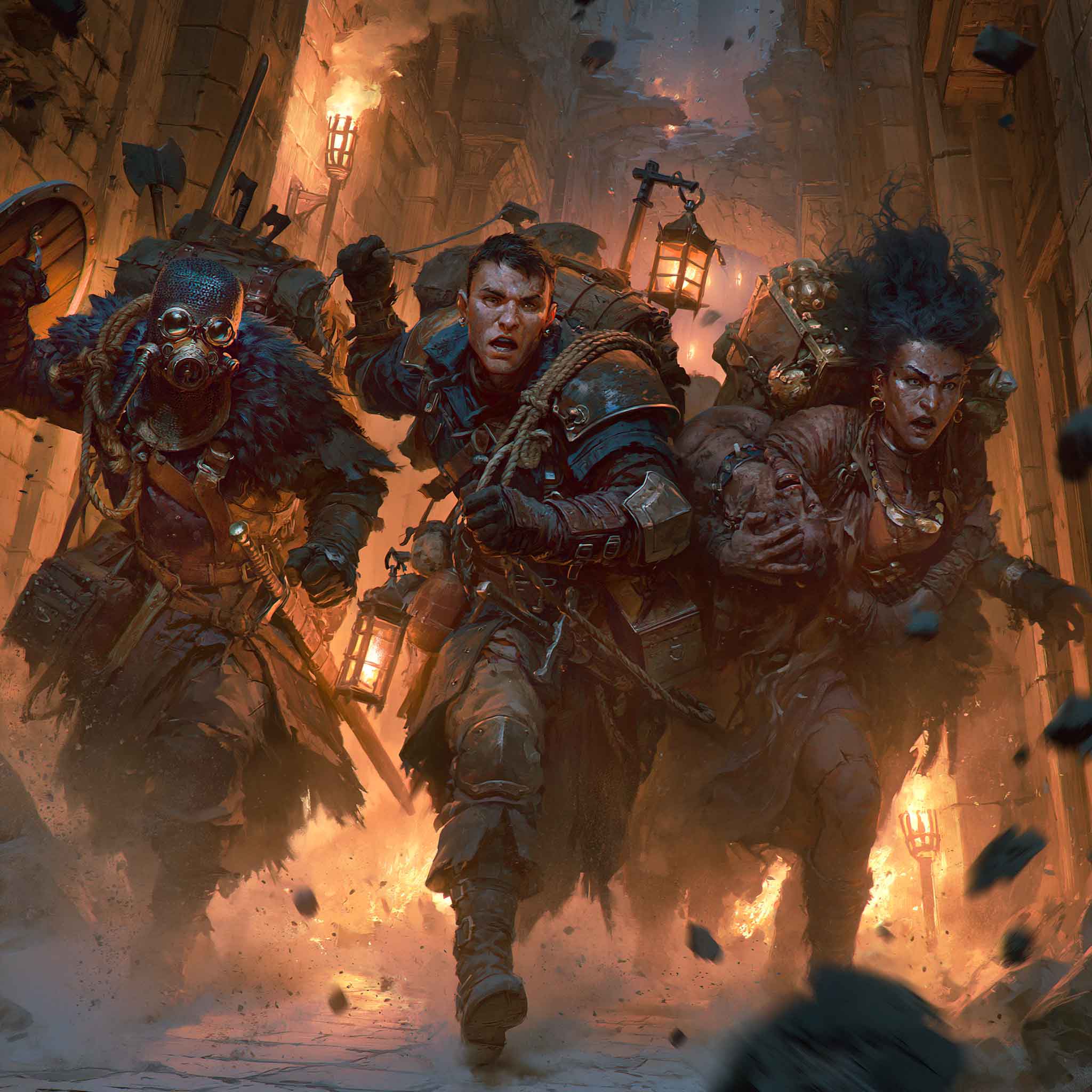
Three characters flee through an unstable gallery with a heavy coffer and an unconscious ally. The DM activates pressurized 5e inventory because load affects speed, free hands, and tactical decisions. - Limits.
The scout has a Strength modifier of +1 and a Proficiency Bonus of +3, so she has 7 Anchors. She carries a backpack, bow, rope, tools, rations, and the coffer: 6 Anchors. She declares the rope and bow as Live Anchors. - New load.
The warrior wants to carry the unconscious ally. The DM rates this as 3 Anchors. The warrior has a limit of 8 and already carries 7; he rises to 10, so he gains Overload 2: Speed −10 ft and Disadvantage on climbing, swimming, or agile movement. - Announced cost.
The DM says: “If you fail the next crossing, you do not automatically fall; you must choose between losing the coffer, becoming separated, or making the ally exposed cargo.” The d20 already has teeth before it rolls. - First obstacle.
The floor splits. The warrior tries to jump while carrying the ally: Strength (Athletics), DC 15, with Disadvantage from Overload 2. He is proficient, so he rolls d20 + Strength modifier + Proficiency Bonus. Final result: 14. - Failure by 1.
The scene does not stop. The warrior crosses, but pays a cost. He chooses to become separated: he reaches the other side, but lands on one knee and cannot help the scout until his next turn. - Live gear.
The scout uses her rope, a Live Anchor, to secure the coffer. The DM grants Advantage on Dexterity (Acrobatics), DC 15, because the preparation was visible before the danger. Result: 19. She crosses and keeps the loot. - Buried item.
The third character wants to pull out a crowbar to jam a door. It is Buried. The DM asks for Dexterity (Sleight of Hand), DC 10, because there is haste but no direct attack. The character fails with a 7: the crowbar comes out, but falls noisily. The door is jammed, but the threat gains a clear clue. - Load Tug.
A tremor hits everyone. The DM calls for a Dexterity saving throw, DC 15. The scout fails and chooses to turn the rope from Live to Buried instead of losing movement. She can no longer use it for Advantage without spending an action to reposition it. - Closure.
Once outside, the group reorganizes. They abandon rations to reduce Overload, strap the coffer to the warrior, and make the rope Live again. The scene did not punish having gear: it turned every burden into a decision.
Mini-Glossary
- Anchor: an abstract unit of scene-relevant load.
- Live Anchor: accessible gear that can help or hinder immediately.
- Buried Anchor: stored, tied-down, or hard-to-reach gear.
- Overload: temporary excess load that reduces Speed and complicates physical movement.
- Load Tug: a saving throw caused by impact, falling, or chaos affecting equipment.
Quick DM Guide
- Do: activate this system only when load changes decisions.
- Do: reward players who prepare gear before danger appears.
- Do: offer selectable costs when failure is partial.
- Do not: count every pound or minor object.
- Do not: use Overload as a permanent punishment.
- Do not: change the cost of failure after seeing the roll.
Common Questions

![[D&D] The 3-Clock Journey for 5e: Hexless Travel That Matters](https://oneman-rpg-studio.com/wp-content/uploads/2026/07/0004-The-3-Clock-Journey-for-5e.jpg)