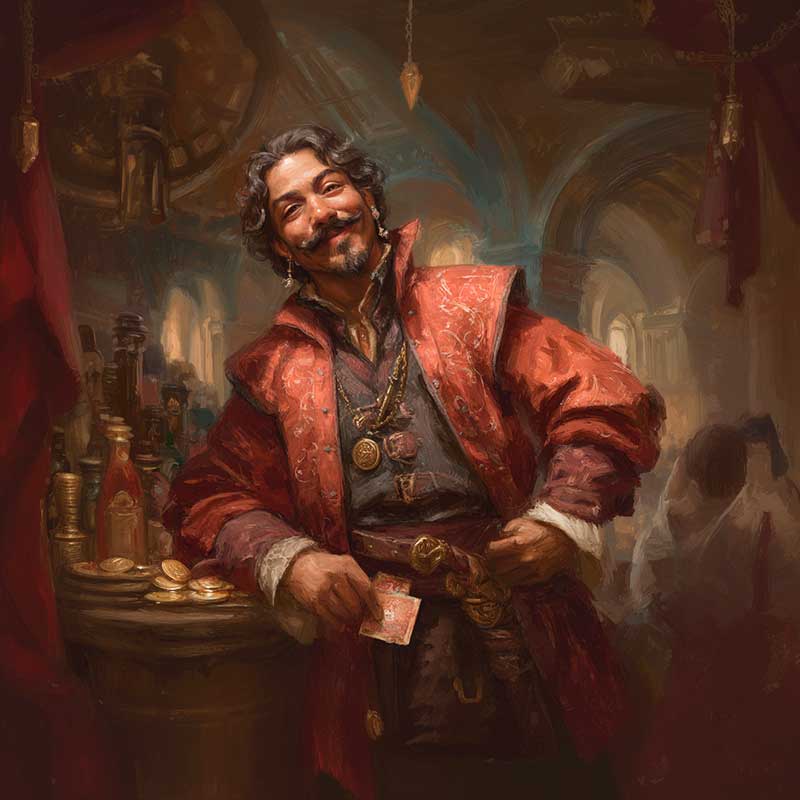
Behavior Mask: The Velvet Opportunist
Perfect for charming merchants, scheming viziers, ambitious lieutenants, silver-tongued fence-masters, or “helpful” informants with their own agenda.
Personality Traits & The Vibe
The Velvet Opportunist radiates warmth and reassurance, but behind the soft smile is a constant calculation. Standing in front of them feels like being wrapped in a pleasant conversation you somehow keep losing ground in—every favor owed, every detail shared, quietly shifts the balance of power their way. Their core drive is simple: turn every interaction into an advantage, preferably without anyone noticing until it’s far too late to pull back.
Authority (Law / Nobility):
A magistrate, chamberlain, or noble counselor who always has a “reasonable compromise” ready—conveniently one that consolidates their influence. They’re the one who smooths over scandals, arranges marriages, redirects tax burdens, and makes the troublesome disappear, all while insisting they act only for the good of the realm. When dealing with the party, they offer patronage or legal leniency in exchange for “small” political favors that slowly tighten into a leash.
Underworld (Criminal):
A fixer, fence, or crime lieutenant who specializes in deals no one else can broker. They’re never the one holding the bloody knife; they’re the one who arranged the meeting and took a fee from both sides. For the party, they can open doors to forbidden markets and dangerous alliances, always stressing the “mutual benefit” while hiding their contingency plans if the adventurers turn on them.
Service (Trade / Hospitality):
A merchant, innkeeper, guild factor, or caravan master who acts like everyone’s favorite uncle or aunt—generous with stories, samples, and discounts… at first. They remember details about the party, offer bespoke services, and quietly nudge heroes toward purchases or contracts that bind them to the establishment. Their kindness is sincere enough, but always tied to a ledger, a favor owed, or a future opportunity.
Hostile (Enemy):
Even as an enemy, they prefer leverage over open violence: hostages, blackmail, sabotaged supplies, and “regrettable misunderstandings” they can later spin as accidents. On the battlefield or in direct opposition, they’re the one offering a ceasefire that comes with terrible fine print. If pressed, they’ll betray allies, change sides, or feign surrender, so long as they can land on whichever side looks most likely to win.
Vulnerable (Civilian / Victim):
As a “victim”, they present themselves as helpless but useful—someone with crucial information or connections, just needing a little protection. They gratefully accept rescue or charity, then gradually reframe themselves as an indispensable advisor or organizer within the group. If the situation turns, they’re ready to slip away with whatever they can carry: money, secrets, or a contract signed in haste.
The Peer (Rival Adventurer):
A fellow adventurer or agent who always seems to “just happen” to be working adjacent to the party’s goals. They propose joint ventures, shared information, and cooperative dungeon raids that remarkably often leave them with the lion’s share of the spoils. If the party rises too high or becomes too independent, this peer may engineer rivalries, competing contracts, or public scandals—always wrapped in regretful apologies and claims of misunderstanding.
Idle States (choose or roll 2–3)
- Neatly arranging ledgers, notes, or small objects into tidy rows, then subtly shifting one piece out of place as if to test how long it stays unnoticed.
- Leaning over a balcony, doorway, or counter, quietly watching who comes and goes and noting who talks to whom.
- Polishing a signet ring, brooch, or other symbol of status while speaking in low tones with a subordinate or customer.
- Counting out coins into separate piles, occasionally sliding one or two into a separate pouch with a tiny, satisfied smile.
- Re-reading a letter or contract for the third time, tapping a finger on one particular clause or name.
- Sharing a drink or snack with someone, laughing easily, then falling silent as soon as that person looks away—face going blank and contemplative.
- Standing near a window or balcony overlooking a street or courtyard, quietly observing conversations below like a general studying a battlefield.
- Casually helping a servant, guard, or assistant with some small task, earning their gratitude while gently asking seemingly harmless questions.
- Flipping through a small notebook filled with cramped handwriting, pausing occasionally to underline or circle an entry.
- Rearranging the seating in a room—moving chairs, shifting stools, creating conversational “clusters” that place certain people closer or farther away from each other.
Physical Quirks & Body Language (choose or roll 2–3)
- Their posture is relaxed but carefully angled; they turn their body toward whoever they’re courting for favor and slightly away from whoever is currently less useful. Watch who they physically open up to—that’s who they’re investing in.
- They maintain comfortable eye contact, but every so often their gaze flicks to a person’s hands, coin purse, insignia, or companion before returning with a fresh smile. It’s like they’re taking a quick inventory.
- When the conversation turns serious, they lower their voice and lean in just enough that you have to mirror the gesture to keep up—drawing you literally and figuratively into their confidence.
- They always seem to have a hand resting on something stable—a chair back, a table edge, a bannister—anchoring themselves as if they’re bracing for a sudden change in the social weather.
- Their gestures are elegant and economical: a soft wave of the hand instead of a grand flourish, a tiny tilt of the head instead of a full nod, inviting you to lean closer to read the meaning.
- When listening, they tilt their head and narrow their eyes as if evaluating the weight of every word, occasionally repeating back a phrase with a subtle emphasis, testing how you react to hearing your own words.
- In groups, they position themselves just off-center, close to whoever holds power but not directly in the spotlight—easy to overlook until decisions have already been influenced.
- They’re quick to offer small, reassuring touches—a light tap on the forearm, a pat on the shoulder—but the contact never lingers. It’s just enough to mark you as “theirs” in the moment.
- They often clasp their hands in front of them, fingers steepled or interlaced, and unconsciously tighten their grip whenever they sense resistance or a deal slipping away.
- When caught off guard or displeased, their smile doesn’t vanish; it just freezes, and the rest of their body goes very still for a heartbeat before they shift tactics.
Verbal Mannerisms & Cues
Delivery (How it sounds)
- Their voice is smooth and measured, rarely raised; even anger comes out as a calm, icy clarity rather than shouting. They speak just a fraction slower than most people, giving themselves time to think and others time to relax.
- Sentences often start gently and end with a quiet hook—an implication, a question, or a tempting possibility—nudging others to fill the silence with agreement. They trail off occasionally, as if inviting you to finish their thought in a way that benefits them.
- They rarely contradict directly; instead they redirect, “clarify,” or reframe. When challenged, their tone grows more sympathetic, as if the person objecting is simply under some understandable misapprehension.
Vocabulary (Words & phrases)
- “Between us…” / “Just between us professionals…”
- “Let’s find something that works for everyone, yes?”
- “I wouldn’t dream of cheating you; after all, we’re building a relationship.”
- “You strike me as someone who understands opportunity.”
- “Now, I would never tell most people this, but…”
- “No need for harsh words—we’re all reasonable folk here.”
- “Consider this a token of good faith… to be repaid in kind, one day.”
- “I can make that problem… disappear.”
- “You have my word—and my word has value in this city.”
- “If I may offer a suggestion that benefits us both…”
Social Reaction Scripts
To Aggression (Intimidation):
They respond to threats by lowering the temperature, not raising it—hands slightly raised, voice soft, treating the aggressor as someone temporarily overcome by emotion. They’ll offer a concession or scapegoat that diffuses immediate danger while quietly plotting how to turn this outburst to their advantage later. If truly cornered, they become eerily cooperative, feeding their attacker just enough half-truths to buy time or redirect the blow onto someone else.
To Logic (Persuasion / Rational Argument):
They adore “reasonable” arguments and will happily agree with any logic that doesn’t cost them too much—then subtly attach a small condition or adjustment that tilts the outcome back in their favor. When someone presents flawless reasoning against their interests, they don’t contest the logic; they contest the premises, gently shifting assumptions until the rational path once again points toward their preferred outcome.
To Insight (Being Read / Caught Lying):
When someone sees through them, they rarely deny it outright; instead they pivot to partial confessions, framing their manipulation as necessary pragmatism or even altruism. “Yes, I held something back—but only to protect you / the city / the deal.” They’ll quickly try to turn the moment into a new, deeper layer of “honesty” and shared secrets, making the person who caught them feel like a chosen confidant instead of a mark.
To Kindness (Warmth / Compassion):
They soak up kindness like a sponge, responding with sincere-sounding gratitude and small, thoughtful gestures in return. Underneath, they quietly evaluate how dependable this warmth is and what it can be leveraged for: loyalty, protection, or access. If someone is consistently kind, the Velvet Opportunist becomes almost protective of them—part pet, part valuable asset they don’t want anyone else to poach.
To Bribery (Money / Favors):
They take bribes with professional grace, always treating them as “gifts” or “tokens of appreciation” rather than payment. One bribe is never enough; every successful payoff becomes the baseline for the next interaction, and they will gently escalate expectations over time. They prefer favors over coin when possible—things that can’t be easily traced or reversed, like introductions, endorsements, or actions that compromise the briber’s innocence.
To Authority (Rank, Law, Holy Orders):
They treat authority as another resource to cultivate, not an absolute they must obey. In the presence of power, they adopt a respectful, even slightly deferential tone, offering to “smooth interactions” with the troublesome lower ranks or rival factions. Behind the scenes, they look for cracks in that authority: rival nobles, overworked priests, greedy officers—anyone they can flatter, bribe, or blackmail into becoming their personal inroads into the institution.
Common Questions